Prologue
How Bad Is It? Worse than you think
A university does not have to close to disappear.
It can remain open while losing the people, subjects, research and institutions that made it worth having. The sign stays above the entrance. Students still arrive in September. There is still a vice-chancellor, a prospectus and an open day. But another department has gone. Another laboratory has closed. Another hundred jobs have disappeared. Another course is no longer offered. The university survives. There is simply less university inside it.
This is already happening.
If you work in a British university, it probably has the reassuring vocabulary of temporary difficulty. There is a restructuring. Posts are frozen. Colleagues are taking voluntary severance. Departments are told to recruit more students, win more grants, improve their scores or otherwise perform their way back to safety. Savings must be found. Efficiencies must be made. The institution must become leaner, more agile, more sustainable.
The language suggests a storm: violent, costly, but temporary.
The storm may not pass.
What looks like a period of austerity is becoming a structural contraction of British higher education. If the system described in this book remains substantially unchanged, universities will employ fewer people, teach fewer subjects in fewer places, conduct less research and contain fewer independent institutions. Some will merge. Some may eventually fail. Many more will remain conspicuously open while becoming smaller versions of what they were.
The danger is not that every university disappears. It is how much university will be left inside those that survive.
Nobody knows how much smaller the sector will become. The important point is that nothing in the present model automatically stops the contraction. The underlying activities remain underfunded. The cross-subsidy that concealed the gap is weakening. Many institutions have already taken the easy savings. What comes next is harder to reverse: people, courses, laboratories, buildings and, eventually, institutions.
Being good at your job may not save your job.
Universities do not necessarily close the courses with the worst teachers, dismiss the least productive researchers or remove the least conscientious administrators. They remove activities they can no longer afford. A brilliant medieval historian can disappear because medieval history disappears. A productive scientist can disappear because the laboratory becomes unaffordable. A successful researcher can even deepen the financial problem if the grant does not pay the full cost of the research. Excellence and affordability are different things.
There is another comforting assumption inside the sector: if the worst happens here, I will go somewhere else. That works during an institutional crisis. It works much less well during a sectoral contraction. A university can reduce its deficit by removing hundreds of posts. Those hundreds cannot collectively solve the problem by applying to universities removing posts of their own.
The same contraction reaches beyond jobs. Students get fewer specialist options and less support. A regional subject offer disappears. A research group stops recruiting and is left to expire politely. A campus loses half its purpose while retaining most of its buildings. The university remains open, which allows everyone to describe what happened as change rather than loss.
That is the danger. Not collapse everywhere, or all at once. Narrowing, repeated until the smaller institution is treated as the institution that was always intended.
First came underfunding, and universities compensated for it. Then came crisis, and they drew on reserves, recruited internationally, borrowed, froze posts, deferred maintenance and cut costs. Now the compensating mechanisms are themselves failing. We are no longer near the beginning of that sequence.
The crisis extends across UK higher education, but the particular funding and regulatory machinery examined here is chiefly England’s; Scotland, Wales and Northern Ireland operate different systems.
The short version is brutal. Research has been underfunded for years and kept alive by subsidy. Teaching many home undergraduates in England has gradually moved from squeezed surplus into structural deficit. International students became the patch, then the business model, then the addiction, then the political target. The income line that held the whole arrangement together is now wobbling. And when it wobbles, universities cannot respond like normal companies, because they are not normal companies.
Faced with rising costs, a normal company can raise prices, cut costs or walk away. Universities have fewer clean options. In England, they cannot raise the main home undergraduate fee to match their costs or abandon students halfway through a course. Even making the product smaller is difficult. A Toblerone can shrink with barely a press release. A chemistry degree cannot quietly lose its laboratory component and hope nobody notices.
Some of the least profitable work is precisely what universities exist to do: educate local students, teach expensive subjects, sustain fragile research and fulfil civic responsibilities that were never designed to pay for themselves. The visible price is not the real price, and the students who pay more cannot be relied upon indefinitely. University finances have come to depend on international fees even as international students are periodically presented as a political problem. That is the part of the story where the absurdity stops being amusing.
The result was not immediate collapse. Universities are good at delay. They can defer maintenance, stretch staff, borrow, restructure and call decline transformation. For a while, this produces the most dangerous kind of institution: one that is deteriorating while still functioning.
The lights are on. The open day banners are up. The prospectus has smiling students in buildings whose maintenance backlog has become a theological concept. The website speaks of excellence, belonging, enterprise and global impact. The accounts contain enough adjusted measures to keep the story alive. The league tables move a little. The regulator writes. The minister speaks. The governors ask for assurance. The staff fill in another workload model. The students receive an email about an enhanced experience. The senior team announces a programme of strategic alignment.
Then the cash runs out.
Not all at once, and not everywhere. Higher education is not one financial object. Some universities are rich, some are strained, and some are one recruitment cycle from the edge. The sector’s habit of speaking as one body is useful for lobbying and useless for diagnosis. There is no single “university crisis” in the sense of one shared balance sheet. There is a system-wide design flaw, expressed through institutions with different assets, debts and luck.
But the pattern is now too large to dismiss as a few badly run institutions with overambitious estates and glossy branding, although there are those too. The deeper problem is that the system has been built on contradictions and then audited for failing to resolve them.
There is a useful test for any public scandal. Ask what the scandal would look like if everyone were telling the truth.
Not the whole truth, obviously. That would be unreasonable. No institution is designed for that. But the partial truths. The things said in annual reports, ministerial statements or vice-chancellors’ briefings. The claims that all seem reasonable when removed from one another and placed gently on separate pieces of headed paper.
Universities say they are underfunded. The government says students and taxpayers deserve value. Students say they were promised opportunity and are leaving with debt, rent arrears and a degree whose price can be changed after purchase. Regulators say they are protecting students, standards and competition. Vice-chancellors say they are managing impossible trade-offs. Universities UK says the sector is a national asset, while trying not to alarm government, markets, applicants or its own members. Everyone has a point, which is the problem.
The crisis is not difficult to understand because the facts are hidden. It is difficult because the facts are distributed across different moral universes. A degree is a private investment and students are consumers. Universities are national infrastructure, except when they are autonomous businesses that should manage their own affairs. Research is a public good, but someone else must quietly meet part of its cost. The same institution is expected to be business, charity, public service, research engine, civic anchor and compliance factory.
Then people look surprised when the accounts become hard to explain.
Universities were expected to compete without being allowed to behave fully like firms. Students became consumers, but universities could not set the price of the main product. Expansion was encouraged without a funding system that honestly paid for it. Research excellence was demanded while research was routinely funded below its full cost. Institutions were urged to diversify their income, then criticised when diversification became dependence.
The contradictions became sharper still around international students: celebrated as an export success when their fees were useful, but treated as an immigration problem when the politics changed. Universities remained notionally autonomous while regulation reached ever further into their operations. Innovation was encouraged in principle, while compliance systems often rewarded documentation more reliably than educational imagination.
The result was a demand for financial sustainability inside a market with a controlled price, hidden subsidies and no clean route to exit. This is not quite a market. It is a market-themed obstacle course. That distinction matters because so much of the blame debate depends on pretending otherwise.
If universities are normal businesses, then the answer is easy. Bad managers over-expanded. They chased overseas students. They built too much. They hired too many administrators. They protected weak courses. They neglected productivity. They indulged ideology. They failed to read the market. Let them fail. There is enough truth in that to make it satisfying, and enough falsehood to make it dangerous.
Some vice-chancellors did make poor decisions. At some institutions, growth postponed harder choices. Leaders opened campuses, expanded portfolios and hired on assumptions that now look less like strategy than weather-dependent optimism. International recruitment was sometimes treated not as one income stream among several, but as a rescue device with a visa office attached. Estate was mistaken for prestige, scale for resilience and a good year for a model.
Institutional leaders did not, however, choose the conditions in which those decisions were made. Holding the English undergraduate fee cap flat for years was government policy. So was a research funding system that left universities to find part of the cost from elsewhere, and an immigration system capable of turning a valuable source of fee income on and off for political reasons. Universities chose how to respond. Poor management can make a bad system much worse without being the reason the system was bad in the first place.
Nor does responsibility sit neatly with students. Some choose badly, overestimate what a degree can do or behave like consumers because they were explicitly invited to do so. But they were asked to make a life-shaping purchase with poor information, uneven advice and repayment terms government could later change. The serious question is who built a system that required seventeen-year-olds to behave like pension-fund analysts with better careers guidance.
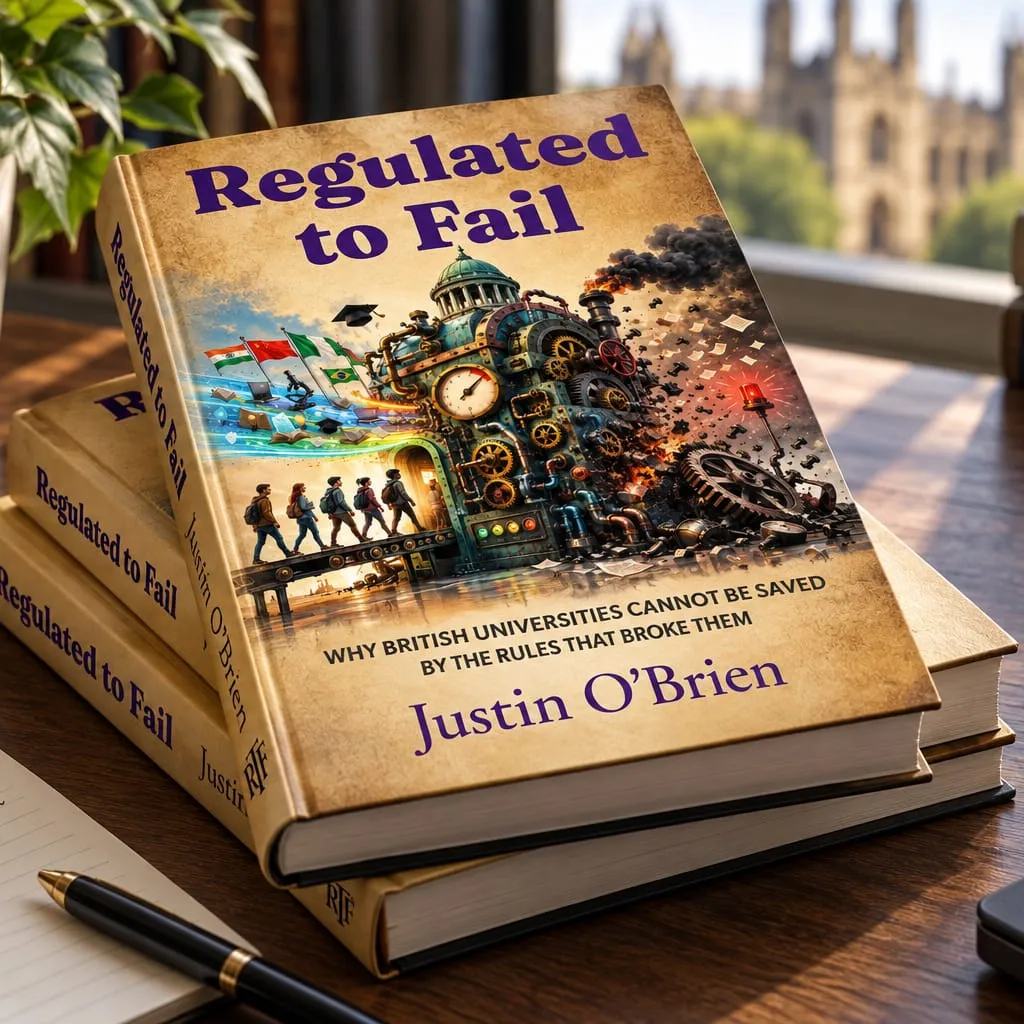
Sector bodies and regulators occupy different traps. Universities UK must represent institutions with unequal and sometimes opposing interests. It must say the roof is leaking without implying the house is unsafe. The Office for Students did not freeze the fee, set migration politics or decide research policy, but regulation has been asked to substitute for coherent decisions about purpose and funding. It stands at the end of a conveyor belt with a clipboard, inspecting objects damaged by the machine upstream.
That brings us to government. “Blame the government” is the simplest sentence in the book and the least sufficient. Government is not one person, one party, one department or one decision. The mess was built by ministers who wanted expansion without tax, markets without prices and autonomy without political risk. Each round of reform solved yesterday’s problem by creating tomorrow’s euphemism.
No single minister woke up and decided to create a sector in which almost every major activity depended on another activity losing less money than expected. That is not how British policy failure usually works. British policy failure prefers consultations, reviews, technical adjustments and a minister saying “world-leading” beside a flag.
The peculiar genius of the current arrangement is that it makes everyone responsible in their own small domain while leaving nobody responsible for the whole. Students must choose wisely. Universities must manage prudently. Regulators must protect quality. Research councils must fund excellence. The Home Office must control migration. The Treasury must protect the taxpayer. Ministers must defend value. Employers must say what skills they need. Governors must ensure sustainability. Sector bodies must speak collectively. Everyone is accountable for one part of the machine, and the machine as a whole is nobody’s fault.
This is why the search for villains is both necessary and misleading. Decisions were made. People signed off budgets, caps and restructures. Harm does not become natural just because it was produced by committee. A financial model that slowly strips capacity from universities while demanding more of them is not weather. It is policy, management and governance interacting over time.
But the search is misleading if it imagines the answer will be one guilty party standing beside the smoking wreckage with a branded tote bag.
The crisis is systemic in the most literal sense. It is produced by the way the parts connect. Underfunded teaching and research encourage universities to chase international income. That income can mask the deficit long enough to support expansion. Expansion creates fixed costs that require further recruitment. Recruitment depends on visa rules, exchange rates, rankings and reputation. Cuts can damage reputation and the student experience, inviting more regulation and adding more cost. The resulting deficit creates pressure for still more international recruitment.
At some point, the business model becomes a snake eating its own risk register.
There is no restoring force in that sequence. Income remains below cost, deficits consume reserves and cuts remove capacity. The weaker institution then becomes more vulnerable to the next recruitment or research shock. Contraction is no longer merely the emergency response. Without a change to the funding and regulatory arrangement, it becomes the equilibrium.
That is how systems fail without a villain worthy of the damage.
Students are harmed first when universities fail badly. They have the least ability to diversify their exposure. A lender can reprice risk. A government can issue a statement. A vice-chancellor can leave. A student midway through a course cannot simply liquidate year two and reinvest elsewhere. Their time, debt, housing, status and plans are tied to the institution’s continuity.
Regions are harmed when universities shrink badly. In many places, the university is not a decorative extra. It is employer, educator, civic anchor and source of local aspiration. Lose capacity there and the damage does not remain on campus. It moves into schools, employers, high streets and the belief that talent can stay.
Research is harmed in ways that are harder to see quickly. The visible project may continue while the hidden infrastructure thins: technicians, doctoral pipelines, seed funding and time. A research system can look internationally successful while quietly eating the institutional subsidy that makes it possible. Then one day the subsidy is gone, and the country discovers that excellence was not floating above the university. It was standing on it.
The public is harmed because a country that weakens its universities weakens one of the few institutions capable of thinking beyond the electoral cycle while also training the people who will staff the next one. That does not make universities sacred. It makes them serious. Serious institutions can be wasteful, vain, complacent, defensive and badly managed. They can also be indispensable. The two facts are not in tension. They are the reason reform matters.
So this book begins with consequences and follows them back to responsibility. The question is not which group can be declared innocent or guilty. It is who controlled what, what they knew or could reasonably have known, what alternatives they had and how much power they possessed to change the outcome.
The story is that England built a higher education system on a sequence of evasions. It wanted mass participation without admitting the public cost, research excellence without paying the full bill and student choice without genuine price freedom. It wanted universities to act commercially without letting them escape public obligation. It wanted autonomy, control, growth, restraint and protection, all at once.
For a surprisingly long time, universities made the contradiction look workable. That may have been their greatest mistake. They absorbed the underfunding, hid the subsidy, stretched the staff and carried on. They made the impossible look merely difficult. In doing so, they protected the country from the consequences of its own model. They also protected the model from scrutiny.
Now the protection is failing. Costs have risen, confidence has weakened and the easy savings have been taken. The hard savings damage the thing being saved. Individual bad decisions matter, but they cannot explain the scale of the problem. Universities need reform, but institutional reform alone cannot repair the system.
Eventually the country has to answer the question it has spent years avoiding: what does it actually want universities to do, and who is going to pay for it?
The bill has arrived. Nobody wants to open it, but everyone is already drafting the press release explaining why it is someone else’s fault.
That is the prologue. The rest of the book follows the money, the rules and the incentives that produced it.